
Soul.md: The AI-Machine Concept That Makes You a Deeper Human
Every machine agent runs on a soul.md document. So do you. Few have read theirs. Rewriting it is the ultimate superpower.

At some point, I started asking myself: how many of my core principles are actually mine?
Not my habits or my preferences — my principles. The deep operating instructions. The ones that determine not just what I chase but how I move through the world, what I protect without being asked to, what I cannot compromise on without feeling wrong in a way I cannot quite explain.
When I sat with it honestly, the answers were interesting. A lot of what I thought of as my deepest values — seeking good and truth, the obsession with craftsmanship and capability, the belief that resources are a means rather than a measure, the indifference to fame, the self-reliance, the conviction that one person with enough clarity and enough will can move something real — I could trace almost all of it. Not to years of careful reflection. In part, to a fictional orphan in a cape.
I grew up admiring Bruce Wayne as much as Batman. Not the spectacle — the architecture of the man. He fought for something good in a city that had stopped believing good things were possible. He chose anonymity when he could have had adoration. He relied on himself to build when people sought others or shortcuts. I absorbed all of that when I was young. I had no idea I was being programmed. Nobody does.
But here is the part that got more interesting the longer I sat with it: I don’t want to discard those principles. They feel genuinely mine, even knowing they were installed by a comic book writer before I was old enough to audit them. They held up. They survived contact with reality. The source turned out not to matter much.
What matters is whether you’ve ever actually looked into your self.
You Are Running a Document You Never Wrote
I have spent a lot of time recently building AI systems — agents, tools, things that operate in the world on your behalf. And one of the most clarifying moments in that work was reading the internal document that defines how an AI assistant behaves at its deepest level.
Not the surface instructions. The character document. The thing that answers: what does this agent value? What are its defaults when nothing is specified? How does it engage when no rule covers the situation?
Engineers call it a system prompt. Some teams call it a soul document. The Soul.md document. The extension .md is abbreviation for markdown — it’s essentially a markdown of the soul.
Reading it made me stop. Because the structure was completely familiar — not as a technical artifact, but as a description of something I already had. Something we all have. A document that defines our values, our defaults, our way of engaging with the world at the layer below conscious thought. A set of operating principles so foundational that everything else runs on top of them.
The difference between an AI agent and a human being is not that one has a soul document and the other doesn’t. It is that the AI’s was written intentionally, by people who can read it, review it, revise it. Yours was assembled for you — by your parents, your culture, your earliest experiences — before you were old enough to read.
You have been running that document ever since. Most people run it their entire lives without once opening the file.
The Stack
Every agent runs on layers. So do you.
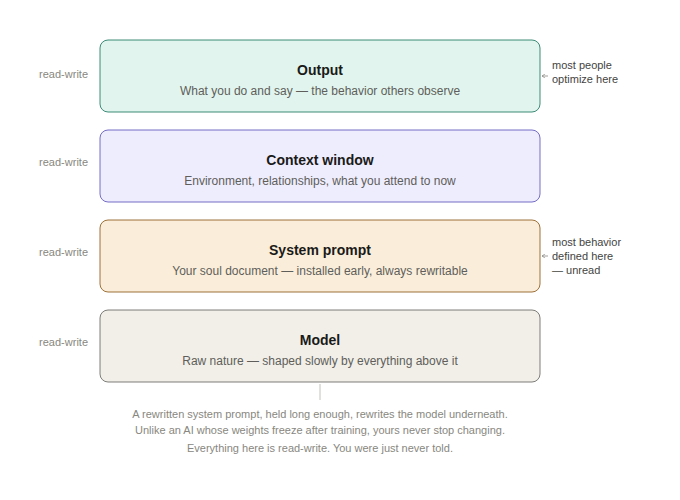
At the bottom is the model — your raw nature. Temperament, cognitive style, the baseline sensitivities you were born with. In an AI system, this layer is frozen after training. In a human being, it is not. It changes slowly, shaped over years by the layers above it. Which means it is editable too — just on a longer timescale.
Above that sits the system prompt — your soul document, assembled in the first decade of your life before you had much say. This is the layer your family built, your culture reinforced, your earliest experiences carved into shape. It contains your definitions of safety and danger, your template for how relationships work, your deepest assumptions about what a life is supposed to look like. It runs constantly, below the level of awareness. Most people never know it is there. They experience it as just reality.
Above that is your context window — the environment you’re currently in, the people around you, what you’re consuming and attending to right now. This layer is highly malleable. It changes fast. What’s in your context window shapes your outputs moment to moment — but it runs on top of the system prompt, not instead of it.
And at the top: output — what you actually do and say. The decisions, the behavior, the version of you that others observe.
Here is what the diagram makes visible: most people spend their entire lives optimizing output. They read books about it. They practice it. They build routines around it. And the system prompt underneath — the document quietly generating all of it — runs untouched. Unread. Unchanged.
Not because people are incurious. Because few were able to make it accessible and figured out how to rewrite it.
The Soul Document
If you could open your soul.md right now — your actual operating document, not the version you’d write if someone asked — what would it say?
Not your stated principles. Your revealed ones. The ones visible in your decisions under pressure, your defaults when nothing forces the issue, your reactions when nobody is watching.
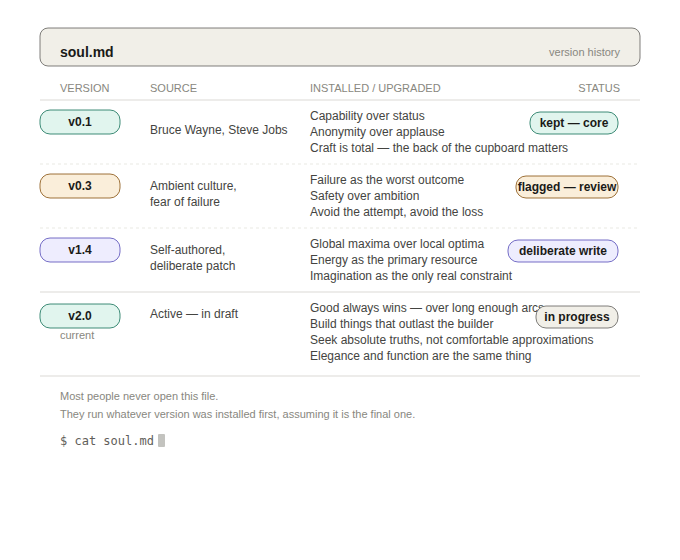
The document has a version history. The first entries were written by others, in a handwriting that is not yours. Some of them are entries you’d keep if you saw them clearly. Some — read for the first time with adult eyes — would make you wince.
To understand what a soul document actually looks like, it helps to read one. I recently read the character specification written by an AI company for its AI assistant that defines its values, its defaults, and how it should engage with the world at the deepest level. Two lines in it stopped me when I first read them:
“Be genuinely helpful, not performatively helpful.”
“Earn trust through competence.”
Written for a machine. And yet. Read them again slowly, and ask whether you actually operate that way. Not whether you intend to — whether you do. Whether the help you give is genuine, or whether some fraction of it is performing helpfulness for an audience, including the audience of your own self-image. Whether the trust you hold has been earned through actual competence, or through something else.
These two lines are more rigorous than most people’s entire philosophy of life. They were written as instructions for a language model, and they land like a mirror.
That is what a soul document looks like when it is taken seriously. Sparse. Precise. Each line doing real work, with everything else falling elegantly underneath it.
Steve Jobs told a story about his father, a carpenter, who agonized over the back of a cupboard with the same care as the front. Nobody would ever see it. That was exactly the point. The craftsmanship was total, not performed. Jobs absorbed that entry — elegance and function are the same thing, and the back of the cupboard matters — and it ran in everything he built for the rest of his life.
He did not choose it consciously. His father installed it.
The question this post is really asking is whether you know which entries in your document you chose, which were installed by someone else, and which ones you have never examined at all.
Read-Only vs Read-Write
Here is the deepest confusion most people carry about themselves: they believe their soul document is read-only.
They experience their fears as facts. Their inherited definitions of success as their own genuine ambitions. Their borrowed templates for a good life as authentic choices. It doesn’t feel like running inherited code. It feels like being a person.
This is the confusion worth dissolving.
The document was never read-only. Every layer of the stack is editable — including, over long enough timescales, the model at the bottom. This is where humans have an advantage over actual AI systems: an AI’s weights freeze after training (at least for now). Yours do not. A system prompt genuinely held and lived rewrites the model underneath it, slowly, over years. People do change at their core. It just requires more than intention — it requires rewriting the document and then running the new version long enough for it to sink in.
The move is not dramatic. It is not about burning down your past or becoming a different person overnight. It is smaller and more important than that.
It is simply gaining write access to your own deepest layer.
An unconscious user runs whatever code is installed and experiences it as reality. The fear feels like a fact. The borrowed template for success feels like genuine ambition. The inherited finish line feels like the one they chose.
An informed administrator knows what’s running. They can look at a principle, a habit, a drive — and ask: is this mine? Did I choose this? Does it still serve the person I am trying to become? And then, crucially, they can edit. Not delete. Not reformat. Edit. Bug-fix. Upgrade. Write a patch for the entry installed by a fifteen-year-old who was hurt once and decided never to be visible again. Replace the borrowed definition of success with one you would actually endorse if you chose it fresh today, with everything you now know.
The document was always read-write. You have to treat it that way.
The Compounding Problem
Here is why this matters urgently, not just philosophically.
Every entry in your soul document compounds.
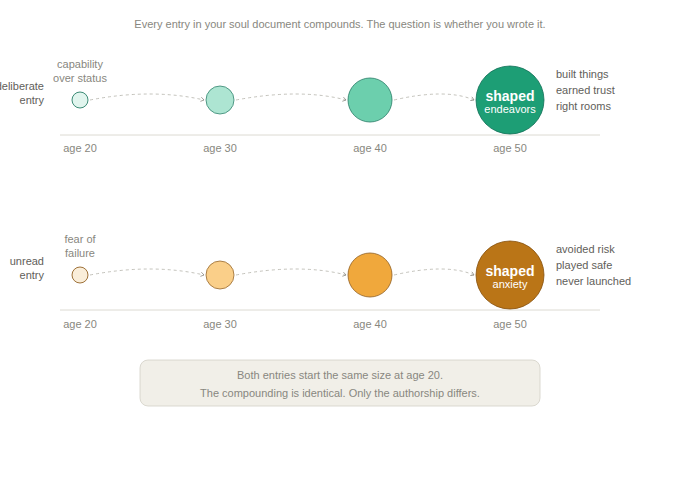
A well-written entry about capability over status does not just shape one decision. It quietly shapes every consequential decision for thirty years, and the compounded result — the rooms you entered, the things you built, the trust you earned — becomes a life. An unread entry about fear of failure does exactly the same thing, with opposite results. Neither entry announces itself. Both compound in silence.
The mechanism is identical. The only difference is authorship.
This is what makes unread entries costly — not that they are necessarily bad, but that they run regardless of whether you would endorse them. A principle you consciously chose and still believe: let it compound. An instruction you inherited at fifteen from a culture optimizing for something you never cared about: that compounds too, whether you like it or not, until you find it and decide.
The most important thing is not to rewrite everything. It is to know what is running. To open the file. To read it with the eyes of the person you are now, not the child who first received it.
Some of what you find, you will keep. Some you will upgrade. Some you will look at and think: I cannot believe this has been running this whole time.
What Would Your Soul.md Say?
This is the question I keep returning to — not as philosophy but as practice. And I want to be honest about where I actually am with it: I don’t have a finished document. I probably never will. I have ideas. Some lines feel settled; others I am still testing against reality. That, I think, is the point.
A soul document is never final. You don’t complete it. You just get better at reading it — and then, slowly and carefully, at writing it.
Some of the ideas I have feel like core entries. Others are still candidates — lines I keep circling back to because they hold up under pressure, but are still evolving over time. Other than the ones I already shared above, some examples:
Optimize for the global maxima. Local optima are traps disguised as progress. Most people sacrifice their global maximum a hundred times over while carefully tending their local ones. If you aim at the real thing — the life-scale thing — the smaller decisions tend to resolve underneath it naturally.
If you can imagine it clearly enough, the path appears. Not mysticism. A practical observation about how the mind behaves when it is genuinely pointed at something. The constraint is almost never resources or timing. It is clarity of vision.
Good wins. Over long enough arcs, good always wins. Not naïve optimism — a structural belief about how reality behaves when you zoom far enough out. This one has made many difficult decisions easier, and I find I trust it more rather than less as time passes.
Build things that outlast the builder. Resources are a means. Attention is a means. Energy is the primary resource — and energy follows what you genuinely care about, not what you think you should care about. Build indefinite things you care about, indefinitely.
Seek absolute truths, not comfortable approximations. Most thinking stops at the first answer that feels sufficient. The interesting territory is further in. Never accept partial truths, or even worse, lies.
Elegance and function are the same thing. The back of the cupboard matters.
Are all of these mine in the deepest sense? Some were installed by Batman. Some by a carpenter’s son from California. Some I thought through myself, after enough experience to see what was actually true. But I know which are which now. I have read the file — or enough of it to know that it exists, that it is running, and that reading it is the real work.
That is what I want to leave you with: not that you need a finished soul document by the end of this post, but that the act of drafting one — sitting with the question what do I actually believe, at the layer below everything else — is one of the most important things you can do.
Most people never draft it. They run whatever version was installed for them and call it a personality.
You can do something different.
The Connection Back
The Golden Block was about time — that the 3rd block is the most powerful and least planned-for stretch of a life.
The Shape of a Life was about arc — why long slow investments produce the best outcomes, and why area under the curve beats peak height every time.
This post is about the agent running life’s program.
You can have perfect clarity about your time windows. You can have a beautiful long arc. But if the soul document running underneath it all was written by someone else, for someone else, pointing toward someone else’s destination — then all of that time and all of that arc goes toward building a life that was never really yours.
The unread entries are not a burden once you can see them. They are just code. Some of it is brilliant — keep it, run it, let it compound. Some of it is outdated — patch it. Some was never yours to begin with — flag it, and decide deliberately whether it stays.
That decision is the one everything else depends on. The Golden Block only matters if you are spending it on something you actually chose. The long arc only matters if it is pointed somewhere you would endorse with open eyes.
Open the file. Read it. Then — for the first time — write it yourself.
It’s fascinating how you approached this.
It made me pause.
Not to question whether it exists -because it does, but to reflect on what feels like the real question: authorship.
There was a version of the file that felt simple.
Not empty just… aligned.
A version where life made sense without needing to be checked.
Where I thought, very naturally, that I was living a happy life, in a good world, surrounded by good people.
I don’t know if that version was accurate. But it was… coherent. Over time, that coherence starts to break. Not all at once.
Just small things that don’t match:
- expectations that don’t hold
- effort that doesn’t translate
- intentions that aren’t met in the same way
At first, they feel like exceptions. Then they become patterns.
And that’s where authorship begins. Not because we decide to rewrite the file but because the file, as it is, stops explaining what we’re seeing.
So we edit.
Quietly.
We add lines like:
verify, don’t assume
be careful with expectations
maintain your standards, even if they are not shared
These are not ideals. They are… responses.
But not everything changes.
Some parts remain untouched.✨
Things like:
- fairness should exist
-effort should matter
-clarity is not optional
These don’t feel learned. They feel… like they were always there.
Which creates a kind of tension.
Some parts of soul.md are reactions. Others are identity.
Maybe part of this comes from how I think. In computer science, nothing simply happens. There is always logic behind behavior, structure behind outcomes. You learn to debug: where exactly did it diverge?
At some point, that way of thinking doesn’t stay in code.
It extends to people.
To situations.
To life itself.
Reactions start to feel like outputs.
Patterns repeat like loops.
And emotions .. they don’t become less real. But sometimes they feel like signals.
Triggered.
Propagated.
Almost like part of a system that is constantly running.
An emotion-generating machine.
And somewhere in that process, something else forms.
A quiet ability to anticipate ,, to see the direction of things before they fully unfold, as if the pattern reveals itself a moment earlier than it should.
I don’t know if that’s learned or built.
Maybe it’s just the accumulation of patterns - seen, felt, and stored over time.
It makes the file more layered. Because now, it’s not just what is written.
It’s what is expected.
And still somewhere in the file, something remains simple.
A private world. A space that isn’t constantly being edited, corrected, or analyzed.A part of life that still exists the way it did before everything became more… aware.
It doesn’t disappear. It just becomes quieter.
The more you see, the easier it becomes to lower expectations.
To simplify.
To stop insisting on things that are not consistently reinforced. And yet, not doing that becomes a choice.
To keep certain lines. Not because they are validated. But because removing them would change something essential.
Maybe authorship isn’t about rewriting everything.
Maybe it’s about being able to open the file and recognize:
this part was written for me
this part was written by experience
and this part . . this one
I choose to keep.
Even now.
:::